Last reviewed: 10 September 2026 · Newest game update reflected: 2026.08.18.12.05 (18 August 2026). Killing orcs before they reach a chokepoint feels like the obvious move, and it's the single most common early mistake in this game. The wave doesn't behave like a line waiting its turn — it behaves like a fluid looking for anywhere it can overflow — and once you see that, chokepoints stop being obstacles and start being the only place your turrets actually matter.
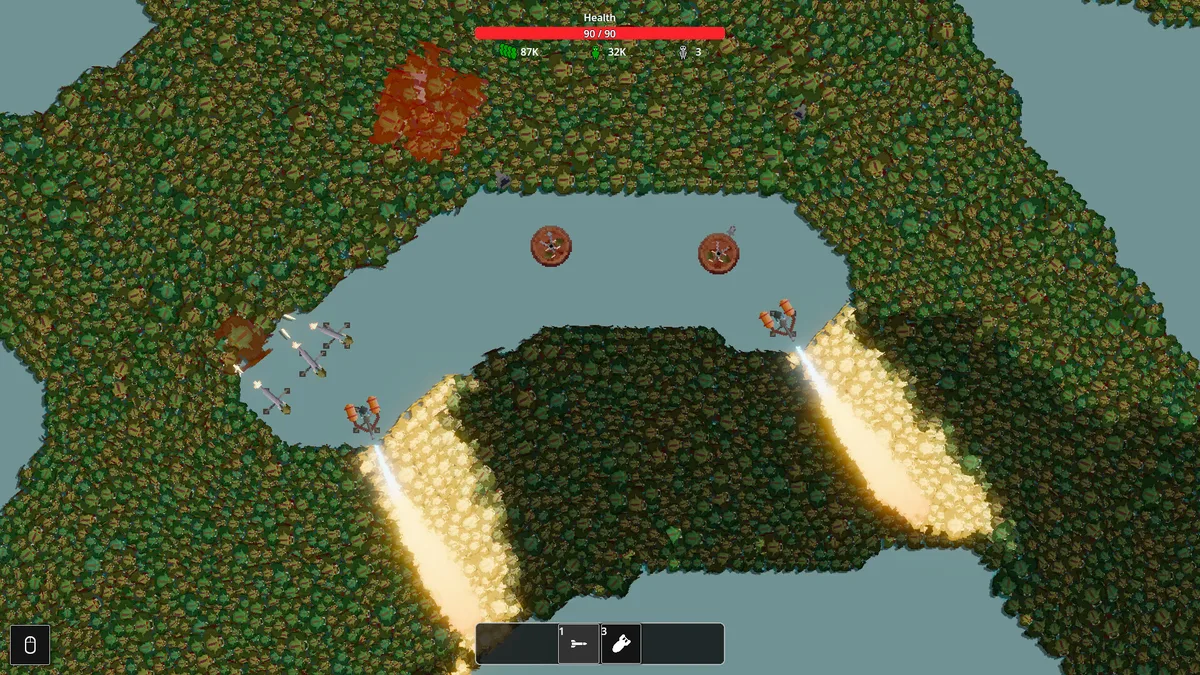
A player named the mechanic before anyone official did
Mumpitz Games has not published a design document explaining how enemy movement works, but a player called deothor described it precisely in a feedback thread months before most strategy guides existed: "my job is to think of the orcs as literally fluid, which i have to scoop out in places it could overflow. Not just kill them 'blindly' where they amass." That post is here: Feedback + Suggestions + 2 possible bugfinds, and it predates every level-specific guide currently cited on this site.
The insight matters because it reframes what a turret's job is. A turret doesn't remove orcs from a queue — it reduces pressure at a point where the flow is already constrained by the map, or it fails to matter at all.
Why killing before a chokepoint doesn't help
A player called Xandor made the same point independently, in the specific context of solving level 4.2: "there are way more orcs appearing than can fit in the chokepoints, so it is pointless to kill them before as it is not thinning them out but if you let them reach chokepoint then that thin them out then as you start killing them it thin them out again." He gave the exact same answer, almost word for word, when asked about level 6.1 in a separate thread — which is itself evidence that this isn't a level-specific trick, it's how the whole game's movement works.
The mechanical reason is throughput, not orc count. If forty orcs are approaching a gap that only fits four at a time, killing orcs in the open field ahead of the gap doesn't change how many arrive at the gap per second — more simply flow in to replace them, because the map is still producing orcs faster than the gap can pass them. The only way to reduce what reaches your base is to reduce what passes through the gap itself, which means your turrets need to be aimed at the chokepoint, not at the crowd building up in front of it.
The same idea, from a written guide
A player named John reached the same conclusion from a different angle, writing what amounts to a short mechanics primer: "Orcs gravitate towards the shortest path to the base and flow like a tide, bouncing off one another to squeeze through. You can make educated guesses as to where they'll be based on corners and other chokepoints which control general direction." His full post is here: Quick and Easy Guide to Orc Problem, and it functions as the closest thing to an official strategy primer this game has, despite being entirely unofficial player observation.
John's guide also separates turret roles along the same lines our turret roles page covers independently: mortars and flamethrowers are for "softening up the herd for picking off" at spawn points and chokepoints respectively, cannons and gunners are for "punching holes in large groupings and picking off units," and ability strikes are better used at the frontline than the rear, since they're bursty rather than precise.
What this means for turret placement
Once you accept that a chokepoint is where thinning actually happens, three placement rules follow directly, and all three are confirmed by player setups on individual level pages across this site:
- Damage turrets belong at or just past the chokepoint, not in the open ground before it. Our 4.2 page and 5.2 page both document setups built entirely around this.
- Slow effects matter more at a chokepoint than anywhere else, because a slowed orc spends longer inside the one place your damage is concentrated. This is why the grenade launcher's 60% slow (see the all turrets page for the full figures) shows up in nearly every hard-level build on this site.
- Cleanup turrets go behind the chokepoint, not on it. Our tesla coil page covers why a 360°, chain-based turret is specifically suited to catching what a chokepoint's damage line didn't finish, rather than doing the choking itself.
Why this explains difficulty spikes, not just individual levels
Our 3.2 difficulty spike page documents a build that scales linearly (more cannons, more damage) failing against a level that requires multiplicative scaling (a laser corridor plus a grenade slow). That's the same flow mechanic expressed differently: a linear build treats every orc as an independent target to remove, while a build that respects the chokepoint treats the wave as a volume to be throttled and slowed before it's killed. The levels that spike in difficulty are, consistently, the ones where the map stops being forgiving about that distinction.
What we have not confirmed
Nothing here is an official game mechanic — deothor, Xandor and John are all describing what they observed, not what Mumpitz Games has stated. We have not seen a developer post confirming that enemy pathing works this way mechanically (as opposed to it simply looking that way from repeated play), and we don't know whether "orc overflow," as deothor calls it, is a deliberate simulation choice or an emergent result of simpler pathing rules. If Mumpitz Games publishes anything more specific about how enemy movement is calculated, we will update this page and attribute it correctly. If you have not read this site in order yet, the where-to-start guide puts this page second for a reason — almost everything else on the site assumes you already have this mechanic in mind.
- Steam discussion "Feedback + Suggestions + 2 possible bugfinds" by deothor, posted 14 May 2026 — origin of the "orc overflow" framing (https://steamcommunity.com/app/4594150/discussions/0/834998803317659960/)
- Steam discussion "Any suggestions for 4.2?" — Xandor's chokepoint throughput explanation (https://steamcommunity.com/app/4594150/discussions/0/589560061703018359/)
- Steam discussion "Quick and Easy Guide to Orc Problem" by John, posted 4 June 2026 (https://steamcommunity.com/app/4594150/discussions/0/561406856400125378/)
- YouTube, "Incremental ORC HORDE Tower Defense (But The Orcs Are Liquid) — Sir We Have An Orc Problem," independent description of the same fluid-like enemy behaviour (https://www.youtube.com/watch?v=dr7W3wXiI3Q)